"48 hours" sounds aggressive for taking a broken app to production, so it's worth explaining exactly what happens in that window — because it's not 48 hours of guessing. It's 48 hours of execution after a diagnosis that already told us precisely what's wrong. Here's the actual process, step by step, using the pattern from real rescues.
Step 1: The scan (usually under an hour)
Before we touch any code, we run a full Launch Readiness scan against the project — secrets scanning (gitleaks and custom rules), static analysis for insecure patterns (client-side database calls, missing auth middleware, disabled SSL verification), dependency auditing for known vulnerabilities, and framework-specific checks (Supabase row-level security, Next.js secrets shipped to the client, Flutter release-build config, and more).
The output is a scored report — a 0–100 Launch Readiness score, findings sorted by severity, and (once you're a client) exactly how to fix each one. This is the same scan behind our free scan, so you can see this step for your own project before you ever pay us anything.
Step 2: The fixed price (before we start, not after)
Once the scan is done, we know the actual scope — not an estimate. That's what makes a fixed price possible instead of hourly billing that can balloon. For a typical AI-app rescue this lands in the Rescue tier (from $149) or, if it also needs full production deployment and domain/DNS work, the Launch tier (from $399). Larger or unusual projects get a custom quote, but it's still fixed before work starts.
Step 3: Critical fixes first, always
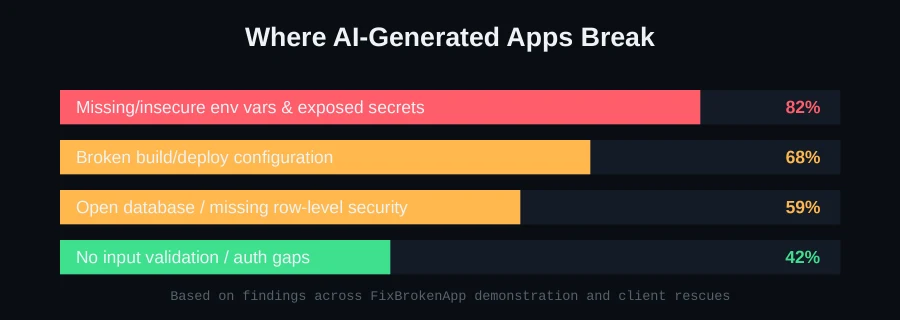
We work in severity order, not feature order. Exposed secrets and open databases get closed before we touch UI polish, because those are the issues that create real risk if the app is already publicly reachable. Only once the critical and warning-level findings are resolved do we move to the "does it actually work end-to-end" pass.
Step 4: Testing end-to-end, not just spot-checking
AI-generated apps often have a "happy path" that works — sign up, click through the demo flow, everything looks fine — and edge cases that don't: duplicate form submissions, concurrent bookings, malformed input, expired sessions. We specifically test the paths a real user would eventually hit that a five-minute demo wouldn't surface.
Step 5: Deployment, with a plain-English handover
For Launch-tier engagements, this includes production deployment, domain and DNS configuration, and making sure auth and payments are wired correctly against live (not test) credentials. You get a plain-English explanation of what was fixed and why — not a wall of commit messages — plus a week of critical support after launch.
A real example: SaaS dashboard, 27 to 94 in 41 hours
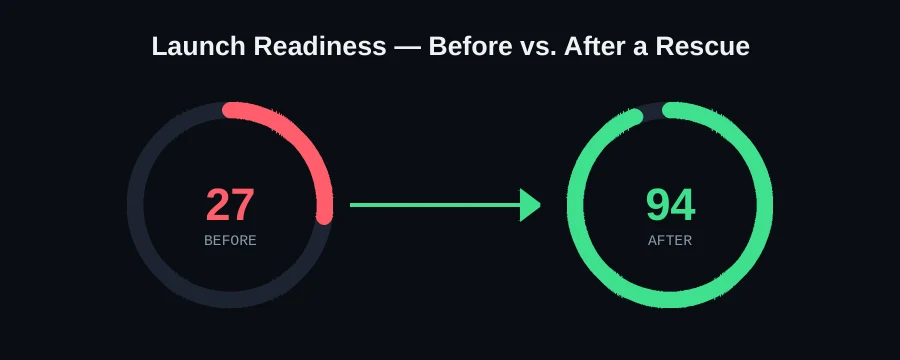
In one real demonstration rescue, a Cursor-built SaaS dashboard had database keys visible to every visitor, all user data publicly readable, and a production build that was silently failing. We locked down row-level security policies table-by-table, moved secrets server-side, and fixed the broken build configuration — Launch Readiness went from 27 to 94 in 41 hours. The Lovable booking app rescue and Flutter fitness tracker rescue follow the same pattern: scan, fixed price, fix by severity, test, ship.
Why "48 hours" is realistic, not a marketing number
It's realistic specifically because the scan removes the guessing. A developer starting from zero on an unfamiliar codebase spends real time just figuring out what's wrong before they can even start fixing it — reading through the project structure, tracing how data flows, forming a mental model of what "correct" even looks like for this specific app. We start with that already done. The scan tells us the exact findings, ranked by severity, before a single fix begins. That's the difference between diagnosing and debugging: diagnosis happens once, up front, systematically; debugging without a diagnosis means re-discovering the same problems reactively, one broken feature at a time, which is exactly what makes ad hoc "just fix it" engagements slower and less predictable.
What "fixed price" actually protects you from
Hourly billing puts the financial risk of scope discovery entirely on the client — if a project turns out to be messier than it looked, the clock keeps running and you find out at the end. A fixed price, quoted after a real scan rather than a guess, moves that risk to us. We've already seen the actual findings by the time we quote you, so the price reflects the real scope, not an optimistic estimate. This is also why we don't quote a price before scanning — a number given without seeing the code is a guess dressed up as a quote, and guesses are exactly what lead to scope creep and mid-project renegotiation.
What "plain-English handover" means in practice
A pile of commit messages and a diff isn't a handover — it's a changelog. For non-technical founders especially, what actually matters is a clear answer to three questions: what was broken, what we changed, and what you need to know going forward (which environment variables exist and why, what to do if a specific error appears again, how to add the next feature without breaking what we just fixed). We write this up directly, in plain language, as part of every engagement — not as an afterthought, but as a deliverable in its own right.
What happens after launch
Launch-tier engagements include a week of critical support after going live — not because we expect things to break, but because the first week after a real launch is when real traffic finds edge cases that a scan and manual testing didn't. If something critical comes up in that window, it's covered as part of the original engagement, not billed separately.
Why the scan-first model produces better outcomes, not just faster ones
There's a version of "fast" that just means rushing, and that's not what this is. The scan-first approach is faster specifically because the diagnostic work happens once, methodically, before any code changes — rather than being spread out reactively across the engagement as each hidden problem surfaces one at a time. This also means the fix order is deliberate: critical security issues first, then functional bugs, then polish — instead of whatever the client happens to notice first, which isn't always what actually matters most for a safe launch. The result isn't just a faster timeline; it's a more complete one, because nothing gets skipped simply because nobody happened to click that particular button during testing.
What we won't do, even under time pressure
A fixed 48-hour window creates a temptation to cut corners, and it's worth being explicit that we don't. We don't ship a fix for the symptom without understanding the underlying cause — a database query that's slow because of a missing index gets an index, not a band-aid cache that hides the problem until it resurfaces at higher traffic. We don't skip testing edge cases just because the demo path works. And we don't consider a security finding "probably fine" because fixing it properly would take longer than a superficial patch. The fixed price accounts for doing it correctly, not for doing it fast at the expense of correct.
How the free scan protects you from a bad estimate
Because the scan happens before any commitment, it removes the single biggest risk in hiring anyone to fix an existing codebase: paying for an estimate that turns out to be wrong once someone is actually inside the code. We've all heard the story of a "quick fix" that turned into weeks of unplanned work — that risk exists specifically when a price is quoted without a real look at what's there. Our process inverts that: look first, quote second, and the price you're quoted already accounts for what the scan found, not what someone guessed from a five-minute skim.
What clients consistently say surprised them most
Across real engagements, the most common piece of feedback isn't about the code changes themselves — it's that they finally understood what was actually wrong with their app, often for the first time. Non-technical founders in particular tend to have absorbed a vague sense that "something is broken" without a concrete picture of what, and a scored report with specific, named findings replaces that vague anxiety with an actual list. Whether or not someone continues to the paid fix, that clarity alone is often the most valuable part of the free scan.
Ready to see your own score?
Send your GitHub link or a zip export on WhatsApp and we'll run the same scan on your project, free — see pricing for what happens next if you want us to fix what it finds. If you want to see the specific issues we look for in the tool you built with, check our guides for Cursor, Lovable, Bolt.new, Replit, v0, and Claude Code.
FAQ
What if my project needs more than 48 hours?
Some do — 48–72 hours is the typical Rescue-tier window, and larger or more unusual projects get a realistic timeline as part of the fixed-price quote, agreed before work starts.
Do I need to know which AI tool caused the problem?
No — the scan works the same way regardless of whether it was built with Cursor, Lovable, Bolt, Replit, v0, or Claude Code. See our full list of AI tools we fix.
What if the scan comes back and my project is actually in good shape?
Then you'll know that for certain instead of hoping — the scan is free, and a clean report is a useful outcome on its own even if you never hire us for anything else.
Do you only work on apps built with AI tools?
AI-built apps are our focus because the failure patterns are consistent and well understood, but the underlying skills span Laravel/PHP, Python, React/Node/Vue, Flutter, and Java — if your project needs a rescue, send it over and we'll tell you honestly whether it's a fit.